From the timing desk — filed by v01d_pr13st before the window opens, scored after it closes.
SUBJECTTwo weeks that are good for finishing, re-checking, and re-pricing work
Two weeks that are good for finishing, re-checking, and re-pricing work — and bad for signing final terms in the last four days.
SUMMARYThe short version
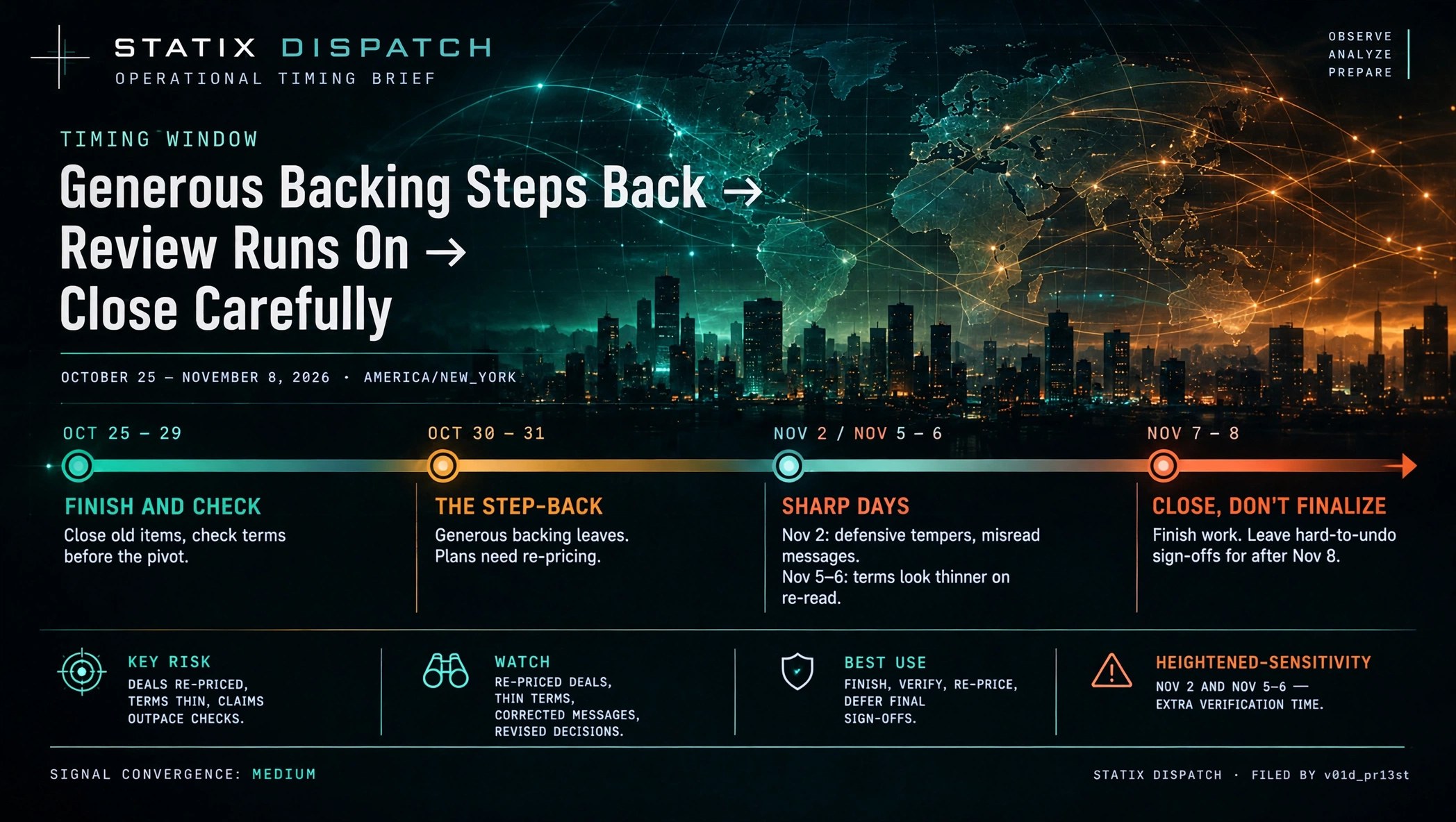
Use Oct 25–29 to finish things that are already in motion and to check the terms on anything still open. On Oct 30–31, the backing behind generous deals steps back: plans that were priced on easy terms need a second look. Nov 2 is the sharpest day in the window — tempers run defensive and messages get misread, so check before you send. Nov 5–6 is the second squeeze: terms that looked fair on first reading look thinner on the second, so re-read contracts and prices before you sign. The window closes Nov 8. Finish work by then. Do not finalize it there.
PRIMARY DRIVERSWhat's moving the window
- Deals and messages under review, all two weeks. Nothing in this window settles on first reading — expect second looks from start to finish.
- Generous terms harder to defend after Oct 30. The backing behind easy deals steps back on Oct 30–31, and plans priced on generous terms need re-pricing.
- Fine print thinner after Nov 5. Terms that looked fair the first time look thinner on the second reading during the Nov 5–6 squeeze.
- A title does not settle arguments. A senior title or a confident tone is not proof — bring the paperwork, not the org chart.
- Disagreements defensive, not attacking. When rows break out, it's sides protecting what they already have, not launching new attacks.
- Claims travel faster than checks. A claim — a rumor, a headline, a confident announcement — spreads before anyone has verified it, then has to be walked back.
EXPECTED EFFECTSPhase by phase
- Oct 25–29 — Finish and check. Close old items, check terms before the pivot. The best days in this window for finishing what's already in motion.
- Oct 30–31 — The step-back. Generous backing leaves. Plans need re-pricing.
- Nov 2 — The sharp day. Defensive tempers, misread messages. Check before you send.
- Nov 3–4 — Steadier ground. The window's steadier phase — election day Nov 3 lands here, but the pressure peaks the day before it.
- Nov 5–6 — The second squeeze. Terms look thinner on re-read. Re-read contracts and prices before you sign.
- Nov 7–8 — Close, don't finalize. Finish work. Leave hard-to-undo sign-offs for after Nov 8.
FROM THE WIRESRegional lenses
The Gulf stays the sharp edge.
What the wires say: the Iran war is in its eighth month. October already has the highest monthly count of Hormuz ship attacks in the war — 27 so far, including six on Oct 11. On Oct 23, a US intelligence memo warned Iranian plotting against US personnel has reached advanced stages, and the State Department pulled non-emergency staff and families from missions in Saudi Arabia and updated travel advisories across the Gulf and Middle East. On Oct 25, Iran said it shot down a US drone over Bandar Abbas. US and Israeli planning, as reported Oct 23, points at possible renewed strikes in early November, after the Nov 3 midterms — and the White House has said plainly there will be no attack before those elections.
What the timing adds: the window's sharp day (Nov 2) and its second squeeze (Nov 5–6) land exactly where the wires say the decisions get made — after the midterms. Expect statements that get walked back, shipping and advisory changes, and loud public debate that is not the same thing as a decision.
What to do: anyone with people, travel, or shipments touching the Gulf should check current advisories and routing in writing before moving, not on the assumption of last week's picture. Watch for revisions, not just first reports.
Beijing goes quiet, then the personnel moves come.
What the wires say: China's ruling Central Committee meets behind closed doors Oct 26–29, with the biggest senior personnel reshuffle on record expected ahead of next year's congress. Provincial chiefs were already named Oct 24. Nothing leaks during the meeting; the official dispatch lands on close. Separately, Taiwan's security agency reports China-origin false and disputed information targeting Taiwan up nearly half this year, ahead of November local elections, and Beijing has threatened unspecified countermeasures after Washington proposed expanding investment curbs on sensitive technology.
What the timing adds: the meeting runs inside the window's "finish and check" days, so the real moves surface on the step-back dates (Oct 30–31) and get re-read on the thin-terms dates (Nov 5–6). A personnel announcement or an investment retaliation that lands Oct 30–31 should be read as priced under the new terms, and re-read again Nov 5–6 before anyone treats it as settled.
What to do: if a deal, price, or supply line touches China, verify its terms in writing after Oct 30 and again after Nov 6. Treat plenum-week silence as normal, not as good news.
Home lens: the midterms sit inside this window.
What the wires say: Nov 3 is election day, landing in the window's steadier Nov 3–4 phase — but the pressure peaks the day before it. The US-overlay lens shows the cost-of-commitments squeeze at its tightest Oct 31–Nov 2, foreign-affairs and messaging friction peaking Nov 2 and again Nov 5–6, and public-standing support arriving only late in the window.
What the timing adds: in plain terms, expect election-night claims to be loud, contested, and revised in the days after — the window's own watch item about corrected messages applies here first. Do not finalize plans on election-night claims. Re-read everything Nov 5–6.
WATCH ITEMSWhat to look for
- A deal or price that was generous gets re-priced or pulled back after Oct 30
- A contract, price, or partnership term re-read and changed Nov 5–6
- A message, version, or document corrected after it went out
- A defensive public row where one side is protecting what it already has, not attacking
- Decisions announced Nov 7–8 that get revised within days
- A Gulf or Hormuz incident, or an advisory change, that gets revised within days
- A post-plenum personnel or investment announcement from Beijing that moves terms after Oct 30
- A midterm-night claim corrected or revised Nov 5–6
BEST USEHow to play it
- Do: finish existing work; verify terms in writing and check the exact version; re-price plans after Oct 30; re-read contracts line by line Nov 5–6; write down who approved what; schedule any final, hard-to-undo sign-offs for after Nov 8; check travel advisories before Gulf or Middle East travel; verify any China-touching deal terms in writing after Oct 30 and again after Nov 6; treat election-night claims as provisional until Nov 5–6.
- Avoid: new commitments Nov 5–8; treating a senior title or a confident tone as proof; repeating a claim nobody checked; sending a heated message on Nov 2; moving people or shipments on last week's Gulf picture.
HEIGHTENED SENSITIVITYNovember 2, and November 5–6
November 2, and November 5–6 — the days when double-checking matters most. Nov 2 is the sharp-message day; Nov 5–6 is the thin-terms re-read. Leave extra time before anything that cannot be undone. (No narrower timing is claimed for this window.)
SIGNAL CONVERGENCEMedium
Statix Dispatch — Operational Timing Desk. This brief describes timing and pressure patterns, not guarantees. Decision-support, to be used alongside real-time information and your own judgment. Filed by the desk — check it against the wires. That's what they're for.